Preparing a reliable freeze-protection strategy for well pumps and related equipment is essential in cold regions. The following well-pump heaters and related accessories are designed to prevent freezing, stabilize temperatures, and safeguard pumps, tanks, and pipes. This guide highlights five top picks with key features to help you choose the right solution for your setup.
| Product | Brand | Key Use | Power |
|---|---|---|---|
| AEGONAN Utility Heater | AEGONAN | Pump houses, utility rooms, remote sites | 600W |
| Qmark WHT500 Utility Heater | Fahrenheat | Well houses, utility rooms, pipes and machinery | 500W |
| H&G Lifestyles Heated Pressure Tank Cover (16″) | H&G Lifestyles | Water well tanks, frost protection | 340W |
| 3-Piece YeloDeer Thermostat Outlet Kit | YeloDeer | Automatic on/off for pump houses, greenhouses | Ambient-controlled outlet |
| Heagstat H721 Non-Programmable Thermostat | Heagstat | Heat pump/central systems control | Non-programmable |
Note: The table summarizes capabilities to help compare core uses, power types, and reliability at a glance. Individual product pages provide detailed specifications and setup instructions.
AEGONAN Utility Heater With Built-In Thermostat

AEGONAN’s 600W pump-house heater is designed specifically for freeze protection in pump houses, utility rooms, relay stations, and similar locations. It features a built-in digital thermostat to simplify temperature control and a passive convection design that improves heat distribution without moving parts that can wear out. The aluminum fin structure enhances heat transfer for quicker stabilization of room temperature, helping maintain equipment operation during cold snaps. This model is suitable for remote installations where maintenance access is limited and continuous operation is critical.
Qmark WHT500 Utility Heater for Well Houses

This 500W heater is designed for use in well houses, utility rooms, and areas housing pipes and machinery. Its galvanised steel construction provides durability against the elements, while a tamper-proof thermostat inside a control box helps maintain safe, continuous operation around the clock. The unit helps prevent pipe freezing and protects connected equipment by providing consistent heat where frost risk is highest. It’s a practical choice for ensuring uninterrupted water supply lines in cold climates.
H&G Lifestyles Heated Pressure Tank Cover (16 Inches)
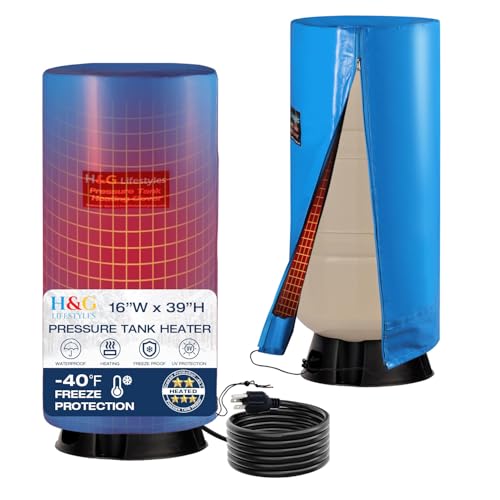
This insulated tank cover is designed to fit standard 16-inch diameter pressure tanks and provides robust frost protection down to -20℉. The 340W heating element maintains a target temperature around 158℉, helping to prevent freezing and preserve water flow. The cover’s insulation minimizes heat loss and reduces energy usage while protecting the tank from temperature swings. A snug fit ensures reliable coverage of the tank surface, enhancing overall efficiency in frost-prone environments.
YeloDeer Thermostat Outlet (1 Pack)

YeloDeer offers a thermostatically controlled outlet that turns power to a heater on automatically when ambient temperatures drop below 38 ℉ and off above 50 ℉. This plug-in solution is quick to install—just plug into a standard outdoor 120V outlet and connect the heater. The unit is built with durable ABS and PC materials for outdoor use and harsh conditions. It provides a simple, affordable way to add automatic frost protection to standby heaters, pump houses, greenhouses, and other exposed equipment.
Heagstat H721 Non-Programmable Thermostat

The Heagstat H721 provides straightforward heat-pump thermostat control with 2 heating and 1 cooling stage, suitable for homes or small commercial spaces. While not a dedicated heater, this non-programmable thermostat helps manage associated heating systems that support well-pump configurations, enabling reliable temperature control and quick compatibility checks with existing setups. It’s important to verify system compatibility and physical fit when integrating with a well-pump application.
Buying Guide: Key Considerations for Well Pump Heaters
When selecting a heater or frost-protection solution for well pumps and related equipment, consider the following factors to ensure reliable operation and energy efficiency:
- Heat output vs. space: Match wattage to the installation area. Smaller pump houses and tanks require less power, while larger spaces or multiple components need higher heat output for uniform warmth.
- Thermostat features: Built-in thermostats, digital displays, and programmable options help maintain stable temperatures and prevent overheating. Tamper-proof thermostats are useful in shared or industrial environments.
- Durability and enclosure: Outdoor-rated or galvanized enclosures protect against moisture, dust, and temperature fluctuations. Durable materials extend life in harsh conditions.
- Cold-weather performance: Look for designs optimized for freeze protection, with fast heat transfer and convection or radiant elements that minimize energy waste.
- Ease of installation: Plug-and-play outlets or simple wiring configurations reduce time and risk. Ensure compatibility with existing electrical panels and circuit capacity.
- Maintenance needs: Units with fewer moving parts typically require less maintenance. Tanks and covers with insulation help reduce energy use and extend equipment life.
- Multiple components: For comprehensive protection, combine a heater with a thermostat outlet or smart controller to automate startup/shutdown in response to temperature changes.
Combination approaches—such as a compact heater paired with a thermostatic outlet—can deliver robust frost protection for pumps, pipes, and tanks while limiting energy consumption and maintenance requirements. Evaluate your site’s power availability, climate severity, and access for routine checks to choose the optimal setup.