Choosing the right 120V baseboard heater can improve comfort while maintaining energy efficiency. This guide highlights five well‑matched options, focusing on steady heat delivery, safety features, and ease of installation. Each product section includes a direct link to the Amazon listing and a visual of the heater. The buying considerations below compare performance, wiring options, and design to help you pick a model that fits your space and power needs.
| Product | Brand | Wattage | Voltage | Notes |
|---|---|---|---|---|
| Cadet F Series 72 in. Baseboard Heater | Cadet | 1500 | 120V | Long, wall-mounted, mid‑range wattage |
| KING 4K1210BW Baseboard Heater | KING | 1000 | 120V | Hard-wired, 4 ft length |
| Cadet F Series 36″ Baseboard Heater | Cadet | 750 | 120V | Compact option, 36 inches |
| King 6K1215BW Baseboard Heater | KING | 1500 | 120V | 6 ft length, hard-wired |
| King 3K1207BW Baseboard Heater | KING | 750 | 120V | 3 ft length, compact |
Note: All models listed are 120V baseboard heaters. When evaluating options, consider room size, heat output needs, and whether you prefer plug‑in or hard‑wired installation for continuous, zone-specific comfort.
Cadet F Series 72-Inch 1500W Baseboard Heater

The Cadet F Series 72‑inch baseboard heater offers continuous heat with a straightforward 120V connection. It is designed for reliable warmth in larger rooms and spaces where a longer heater helps distribute heat evenly. The unit is manufactured in China and emphasizes steady operation over extending periods, which can support consistent room comfort with minimal maintenance.
KING 4K1210BW 4-Feet Baseboard Heater, 1000W

This 4‑foot, 1000W baseboard heater is not a plug‑in model and must be hard-wired for operation at 120V. It features an aluminum ribbon fin element for efficient heat transfer and a full‑length safety cutout to reduce risk during operation. Suitable for rooms that require solid heat output along a wall or under a window for consistent warmth.
Cadet F Series 36″ Baseboard Heater, 750W
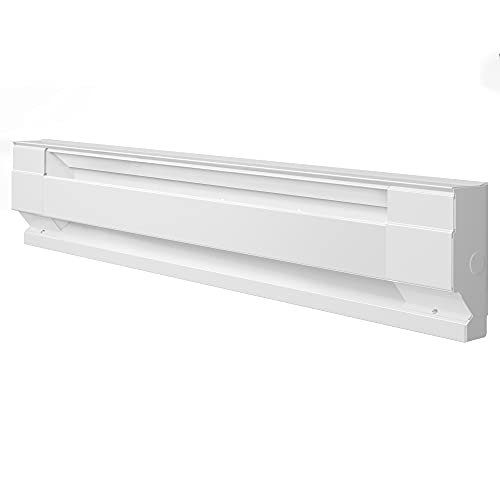
Cadet’s 3F750‑1W model provides 750W at 120V in a compact 36‑inch footprint. It requires a thermostat for control and includes durable steel construction with a 20‑gauge junction box and ground. The design emphasizes all‑metal build quality and powder coating for room‑temperature resilience.
King 6K1215BW 6‑Foot 1500W Baseboard Heater
This 6‑foot baseboard heater delivers 1500W at 120V for larger spaces. It uses an aluminum ribbon fin element and includes a full‑length safety cutout. The unit is not plug‑in and requires hard‑wiring, making it suitable for dedicated heating zones in living areas or bedrooms where consistent heat is needed across a long wall.
King 3K1207BW 750W 3‑Foot Baseboard Heater

The 750W King 3K1207BW provides a compact baseboard solution at 3 feet. It is designed for hard‑wired installation and includes an aluminum ribbon fin element and a full‑length safety cutout, balancing efficiency with space considerations for smaller rooms or hallways requiring steady heat.
Buying Guide: Key Considerations For 120V Baseboard Heaters
Choosing the right 120V baseboard heater depends on room size, installation type, and desired control features. Consider the following perspectives:
- Heat Output and Room Size: Larger rooms may require higher wattage (750–1500W) to achieve comfortable temperatures. For long walls, a multi‑section or longer unit can distribute heat more evenly than a single short heater.
- Wiring and Installation: Not all models are plug‑in. If you prefer a clean look or space without outlets, choose hard‑wired units and plan for thermostat integration or zone control. Universal wiring and knockouts can reduce installation cost and complexity.
- Safety Features: Look for full‑length safety cutouts, high‑temperature shutoffs, and end panels designed to resist dents. Models with tip‑over and overheat protections add safety for households with children or pets.
- Thermostat Control: Some heaters require a separate thermostat, while others include integrated controls. Consider whether you want programmable or digital thermostats for precise temperature management.
- Durability and Materials: All‑metal frames and powder coatings enhance longevity. Aluminum ribbon fin elements improve heat transfer efficiency, contributing to faster warm‑up and even heat distribution.
- Noise and Comfort: Baseboard heaters typically operate quietly, but fan‑less convection designs may still have subtle sounds from metal expansion. Look for models advertised as quiet if the space requires near‑silent operation.
- Maintenance and Access: A shallow profile and accessible wiring panels simplify servicing. Check mounting options, whether the unit is designed for floor or wall installation, and the ease of filter-free design.
When comparing products, map the heater’s wattage against your room dimensions, insulation level, and climate zone. For older homes with draftier walls, a higher wattage or multiple units across adjacent walls can prevent cold spots. For insulated spaces like bedrooms or home offices, a lower wattage unit paired with a programmable thermostat may suffice.